
AI Concepts Explained
Tokens, context windows, hallucinations, RAG and privacy: the ideas that explain how AI behaves.

Why AI Sounds Right and Is Still Wrong: How to Catch Hallucinations
Why language models produce confident errors, which tasks are most at risk, and a simple verification routine for facts, numbers, quotes and citations.

Tokens and Context Windows, Explained Simply
What a token is, why context windows matter, and how both affect cost, speed and answer quality — with rules of thumb you can use today.

RAG vs Fine-Tuning, Explained: Which One Do You Actually Need?
Retrieval-augmented generation and fine-tuning solve different problems. A plain-English comparison, with examples and why most teams should start with RAG.

AI Privacy: What Not to Share With ChatGPT, Claude or Gemini
A practical guide to using AI assistants safely: the information you should never paste, settings worth checking, and simple habits for work and personal use.

Prompt Injection, Explained: Why AI Agents Need Guardrails
Prompt injection is when hidden instructions inside content try to hijack an AI. How it works, why it matters more as agents get access to email and files, and practical defenses.

What AI Temperature Actually Changes (and When to Adjust It)
Temperature controls how random an AI’s word choices are. What low and high settings do, when it matters, and how to get similar control in chat apps that hide the setting.

Open-Weight vs Closed AI Models: What the Difference Means for You
Closed models run on a company’s servers; open-weight models can be downloaded and run yourself. The trade-offs in capability, cost, privacy and control.
Guides that cover this topic
 Beginner to advanced
The Complete ChatGPT Guide (2026 Edition)
Everything you need to use ChatGPT well in 2026: GPT-6 and Intelligent UI, prompting, Projects and memory, voice and audio, Deep Research, agents and staying safe.
6 chapters · Read the guide Beginner to intermediate
The Complete Claude Guide: Models, Projects and Workflows
How to use Claude well in 2026: choosing between Opus, Sonnet and Haiku 5.5, setting up Projects, working with long documents, creating docs and slides, and making usage last.
5 chapters · Read the guide All levels
The Prompt Engineering Handbook
A complete, practical handbook to prompt engineering: frameworks, examples, chaining, critique loops, voice, image prompts and how to verify output.
6 chapters · Read the guideFree tools for this topic
AI Output Checker
Review an AI answer before you trust it.
Token & Cost Estimator
Estimate tokens, context use and API cost.
AI Model Picker
Find the right assistant for the job.
AI Use Policy Generator
A clear AI policy for your team in minutes.
Prompt Builder
Build a complete prompt with the 6-part framework.
Products for this topic
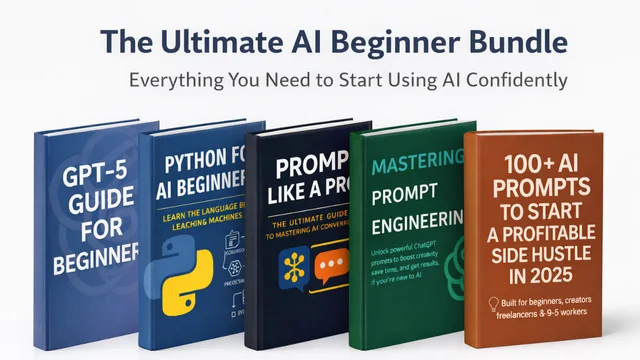
AI Beginner Bundle
Five beginner guides that take you from AI-curious to AI-confident.
AI Agents Guide
Understand, build and sell your first AI agent — with no-code and code paths.
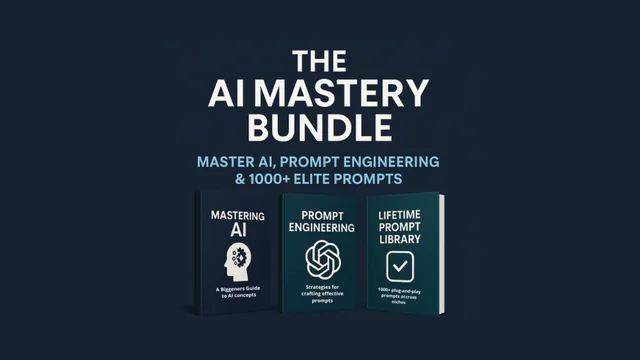
AI Mastery Bundle
The next step after the basics: frameworks, precision prompting and a 1000+ prompt library.
Keep exploring
AI News & Updates
What changed this month in ChatGPT, Claude, Gemini and the tools around them, explained in plain English with sources.
5 articlesPrompt Engineering
Frameworks, fixes and before-and-after examples that turn vague requests into reliable output.
8 articlesChatGPT
Projects, memory, voice, custom instructions and Deep Research: the habits that get more from ChatGPT.
6 articlesClaude
Learn Claude properly: models, Projects, artifacts, documents and how to make your usage last longer.
2 articles