Pinterest is a visual search engine. Use AI to find keywords and angles, but design each pin around one clear promise and a reason to click.
Think search, not social
People use Pinterest to plan and solve problems. Pins that match what they search for keep earning traffic for months. That makes keywords and clear promises more important than posting volume.
Build a keyword cluster
My blog post is about [topic] for [audience]. List 20 Pinterest search phrases people might use, grouped into 4 clusters by intent (learn, plan, buy, fix). Mark the 5 most specific long-tail phrases.
Turn one post into eight pins
- A checklist pin
- A step-by-step pin
- A mistakes-to-avoid pin
- A before-and-after pin
- A quick-tip pin
- A list pin (“7 ways to…”)
- A question pin
- A free resource pin
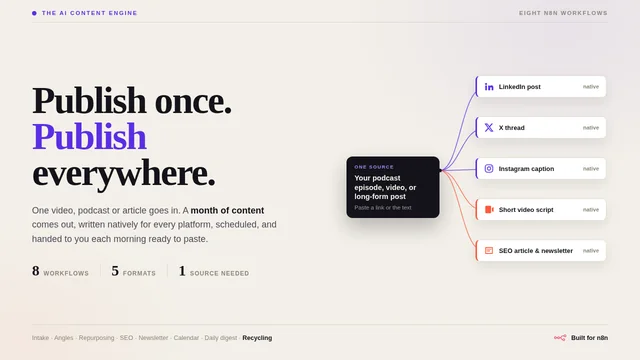
The AI Content Engine
One video, podcast or article in. A month of platform-native content out.
From $89 · Look insideTitles and descriptions
Lead with the keyword, add a specific benefit and write naturally. Describe what the reader gets when they click. Avoid stuffing hashtags or repeating keywords awkwardly.
Views but no clicks?
- The pin answers everything — leave a reason to click.
- The image and the landing page do not match.
- The promise is vague.
- The landing page is slow or cluttered on mobile.
Generate pin titles with our Hook & Title Generator, and automate repurposing with the AI Content Engine.
Put it into practice
Open the free Hook & Title Generator: proven title and hook formulas, filled in for you. This article is part of The AI Playbook for Small Businesses and Freelancers.
Sources & further reading
Product facts were checked against official sources on 16 October 2026. AI tools change quickly, so check the provider’s current documentation for anything you rely on. Our editorial policy.